
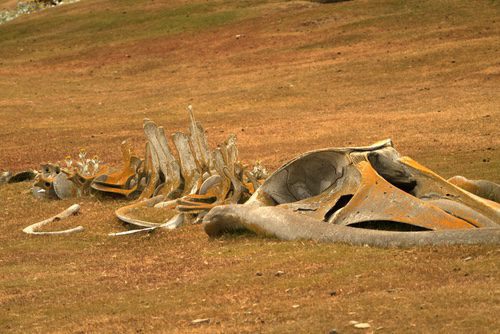
More than a decade ago, a group of paleontologists from the University of Camerino in Italy uncovered a treasure trove of enormous bones while exploring the Pisco Basin in Peru.
These remains, initially thought to belong to an ancient whale, have spent years preserved within Peru’s Natural History Museum while researchers diligently studied their origins.
In collaboration with experts from the University of Pisa, they have now conclusively identified the fossilized bones, leading to a truly astonishing discovery.
Although the Pisco Basin is now a desert at the base of the Andes Mountains, 40 million years ago, during the Eocene period, it was an expansive, shallow inland sea. The researchers have ascertained that the bones they unearthed belonged to a massive whale species that once roamed this prehistoric sea.
They’ve christened this remarkable creature “Perucetus colossus,” and their analysis, based on the spine, ribcage, and pelvis, has yielded fascinating insights into its characteristics.
The remains establish that P. colossus belongs to the basilosaurid family of early-toothed whales, known for their powerful jaws adapted to catch bottom-dwelling prey. What sets this species apart from its relatives is its staggering size.
The ancient whale measured approximately 66 feet in length and weighed up to 340 tons, making it more than twice as heavy as the present-day blue whale, the largest extant animal. It was even three times heavier than the most massive known dinosaurs.
Scientists speculate that this immense skeletal weight served as “ballast,” anchoring the whale to the shallow bed of the Pisco sea, preventing waves from easily displacing it as it hunted.
This remarkable discovery is a significant milestone for scientists, offering valuable insights into the evolutionary journey of whales. Whales, despite being mammals, are descendants of land-dwelling ancestors.
Fossil records reveal a gradual transition from terrestrial creatures to those that spent an increasing amount of time in the water, eventually becoming more aquatic. Paleontologists believe that basilosaurids were the pioneering whales that adapted entirely to aquatic life, with P. colossus providing further confirmation.
While this magnificent creature possessed tiny hind legs in addition to powerful flippers, its immense size made terrestrial movement impractical. Thus, P. colossus was unequivocally a fully aquatic animal.
