
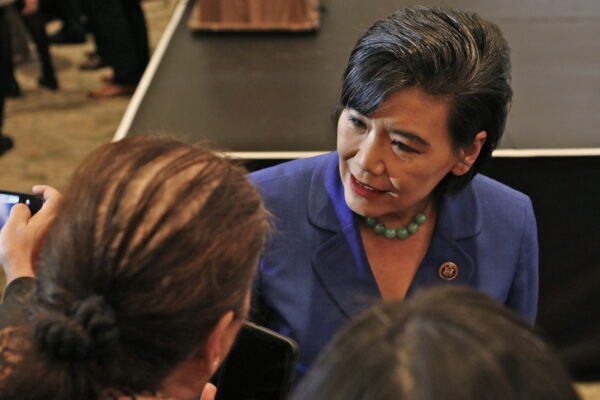
California Democrat Rep. Judy Chu was arrested on Thursday during a pro-choice protest at the Capitol.
U.S. Capitol Police arrested Chu for crowding, obstruction, or incommonding after she along with other protestors blocked the intersection of First Street and Constitution Avenue beside both the Capitol and Supreme Court buildings on Wednesday.
Police arrested 181 people after warning demonstrators multiple times, according to the department.
“The decision to march today was easy—I came out to march for the young rape survivor, the woman who cannot afford to travel to another state to access critical care, the mother with an ectopic pregnancy whose life is in danger. I came out to march for all of us,” Chu tweeted on Wednesday following her arrest.
Protests have been rampant across the country after the Supreme Court overturned “Roe v. Wade,” the controversial case that led to the proliferation of legalized abortion throughout the U.S.
“[I] immediately thought of who would be most harmed by this decision: a young girl who is a survivor of rape, a woman who cannot afford to travel to another state to access critical care, an expecting mother with an ectopic pregnancy whose life is in danger because she cannot have an abortion,” Chu said in a statement when she heard about the case being overturned.
In addition to the protests, liberals are calling for the impeachment of Justice Clarence Thomas with a viral petition that has already reached over 700,000 signatures since its creation.
The petition was started by the public policy advocacy group MoveOn in response to the Supreme Court’s decision to overturn “Roe v. Wade.”
“The right-wing rigged Supreme Court overturned Roe v. Wade last week, effectively taking away the right to privacy and bodily autonomy that’s been considered legal precedent for the past 50 years,” read the petition, which was created by the public policy advocacy group MoveOn.
13 states in the U.S. are expected to enact immediate abortion bans since the ruling with 13 more to follow suit. Some of the bans include certain exemptions, such as ectopic pregnancies, rape, and incest cases, but each law differs by state.
