
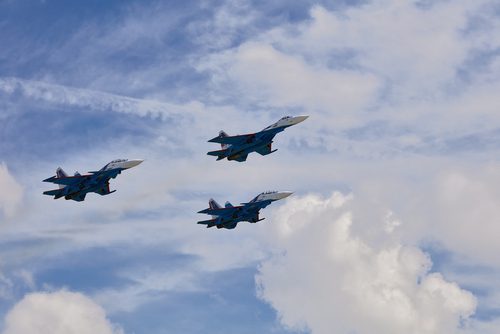
Armed Russian planes flew over a US military garrison in Syria nearly every day in March, violating a 4-year US-Russia deal and risking an escalation, according to the US general in charge of air operations in the region.
lieutenant general Alexus Grynkewich, commander of the combined forces air component of US Central Command, told NBC News on Wednesday that the most recent Russian overflight of the At Tanf Garrison (ATG) occurred just hours earlier and Russian planes violated the space plane about 25 times. So far this month, compared to zero times in February and 14 in January.
“It’s a substantial increase,” he said, explaining that at this rate they are “on track to double what they have been in the past.”
“They are regularly flying directly over our units, and I defined directly above as within about a mile, no more than a mile either side or the other, while we have forces there on the ground at the ATG,” Grynkewich said. “So it’s an awkward situation.”
Russian aircraft include Su-34 aircraft. Some aircraft carry air-to-air weapons and other air-to-ground munitions; weapons include radar-guided bombs, missiles, and heat-seekers. This revelation comes in the wake of an incident over the Black Sea last week in which two Russian Su-27 fighter jets aggressively flew over a US MQ-9 Reaper drone, dumped fuel on the drone, and eventually collided with it, forcing the United States to down the drone in the water.
Grynkewich said he doesn’t believe the Russians have any incentive to use weapons against the US military in Syria. “But it just increases the risk of a miscalculation, and given things like the MQ-9 crash in the Black Sea, that’s not the kind of behavior you would expect from a professional air force.”
The US military used the established anti-conflict hotline it shares with the Russians to protest the actions, but Russian behavior hasn’t changed. Instead, Grynkewich said, during the calls, the Russians have told the United States that they do not recognize all of the airspaces above At Tanf (also known as Al Tanf) as US airspace or that they are responding to coalition activity in the area.
In 2019, the United States and Russia established air rules over Syria to prevent accidental and potentially provocative encounters. Both sides agreed that direct overflights of each other’s ground positions, particularly by armed aircraft, were not acceptable.
“The Russians in recent months seemed to be abandoning that principle of protocols,” Grynkewich said. The Russians still insist that the US stay away from Russian ground units, she explained, and the US is sticking to that. But the Russians have even flown directly over US troops on the ground in southern Syria, calling it provocative.
Grynkewich said the Russians could take a more aggressive stance to put pressure on the US military presence in Syria, something they disagree with. But he said the fact that both the US and Russia are allegedly opposed to ISIS in Syria, and with the continued, and in some cases increasing, presence of ISIS in Syria, “seems like a very strange time to. “
The overflights have not affected US military operations on the ground so far, but the US or the international coalition against ISIS responds to Russian aircraft, often following them from afar. Grynkewich warned that if they were to respond to a Russian flight during a US military operation on the ground, it could jeopardize the mission.
“What it really is is a distraction from fighting ISIS,” he said. “It hasn’t affected the fight on the field yet, but it definitely has the potential to.”
“I’m not concerned about open hostilities, I’m concerned about a miscalculation or an unprofessional or immature action by someone.”
“In my career, I have not seen this kind of disregard for agreed protocols and dispute resolution rules,” she said. “So this is very unique, what we’re seeing right now.”
The Russian embassy in Washington, DC, did not immediately respond to a request for comment.
