
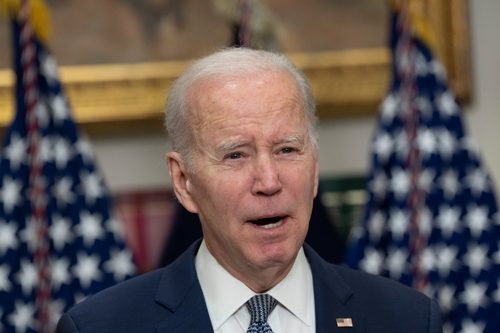
President Joe Biden immediately left the podium on Monday to ignore press questions related to the collapse of Silicon Valley Bank.
Speaking in front of the press regarding the shuttering of SVB by federal regulators, Biden assured that people who had bank deposits could access their money.
WATCH: Biden refuses to take any questions after he delivers remarks on the economy. pic.twitter.com/MiX6vOri9g
— Daily Caller (@DailyCaller) March 13, 2023
“All customers who had deposits in these banks can rest assured they’ll be protected and they’ll have access to their money as of today,” the president said. “We must get the full accounting of what happened and why those responsible can be held accountable.”
Following his speech, Biden bolted the Roosevelt Room as one reporter shouted, “Should all depositors be protected at all banks?”
This comes after SVB, the top financial institution for startup businesses in the U.S., collapsed on Friday after the uncertainty surrounding its risky investments led to a run on deposits. Only a few months ago, it had over $200 billion in assets, making it the 16th largest bank in the country.
Biden suggested that he would push for stronger regulations on financial institutions, but he offered no specific examples or even broad policy proposals.
Meanwhile, former President Donald Trump blasted Biden’s economic policies for the bank’s collapse, warning that further financial calamities are on the horizon.
“With what is happening to our economy, and with the proposals being made on the LARGEST AND DUMBEST TAX INCREASE IN THE HISTORY OF THE USA, TIMES FIVE, JOE BIDEN WILL GO DOWN AS THE HERBERT HOOVER OF THE MODRRN [sic] AGE,” he wrote in a Truth Social post. “WE WILL HAVE A GREAT DEPRESSION FAR BIGGER AND MORE POWERFUL THAN THAT OF 1929. AS PROOF, THE BANKS ARE ALREADY STARTING TO COLLAPSE!!!”
However, many have claimed that the collapse on Friday was a longer-term effect of a law Trump signed in 2018 that lowered restrictions for mid-level and regional banks, like SVB. The bill increased the previous cap of $50 billion in assets, which was imposed in the wake of the Great Recession, to allow banks with assets of over $250 billion to evade the Federal Reserve’s mandated oversight that kept a check on their stability.
