
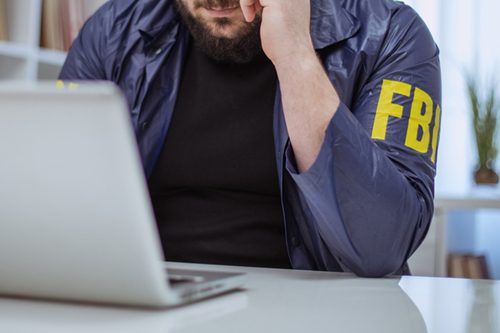
A new report from the House Judiciary Committee revealed that an agent from the Federal Bureau of Investigation (FBI) was tasked with flagging online speech for social media companies such as Facebook and Twitter.
The 104-page report details how the Department of Homeland Security’s (DHS) Cybersecurity and Infrastructure Security Agency (CISA) worked with third-party companies to flag election-related speeches on social media platforms ahead of the 2020 presidential election.
“The Committee and the Select Subcommittee are responsible for investigating ‘violation[s] of the civil liberties of citizens of the United States.’ In accordance with this mandate, this interim staff report on CISA’s violations of the First Amendment and other unconstitutional activities fulfills the obligation to identify and report on the weaponization of the federal government against American citizens,” the report read.
The outside organizations include the Election Integrity Partnership (EIP), a coalition of outside groups that specialize in “disinformation,” including the Stanford Internet Observatory (SIO) within Stanford University’s Cyber Policy Center, and the Center for Internet Security (CIS), which is sponsored by CISA.
“Yet, no government agency in the United States has the explicit mandate to monitor and correct election mis- and disinformation. This is especially true for election disinformation that originates from within the United States, which would likely be excluded from law enforcement action under the First Amendment and not appropriate for study by intelligence agencies restricted from operating inside the United States,” it continued.
This comes after U.S. District Judge Terry A. Doughty ruled recently that the Biden administration has no right to put limits on government communications on social media platforms.
“Although this Preliminary Injunction involves numerous agencies, it is not as broad as it appears,” Doughty wrote in his ruling. “It only prohibits something the Defendants have no legal right to do—contacting social media companies for the purpose of urging, encouraging, pressuring, or inducing in any manner, the removal, deletion, suppression, or reduction of content containing protected free speech posted on social-media platforms.”
The ruling marked a win for free speech advocates, who called it a preservation of Americans’ First Amendment rights. It could also wind up being one of the federal court’s most important cases, especially in today’s political climate.
