
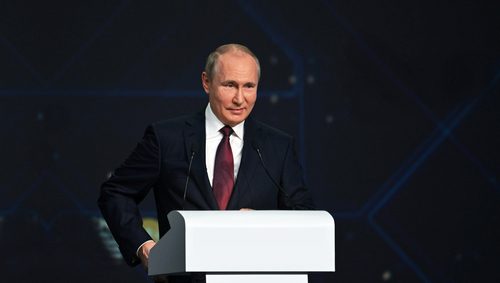
Russian President Vladimir Putin on Tuesday accused Western countries of initiating and supporting the war in Ukraine, pushing all blame on Moscow nearly a year after its neighbor’s unprovoked Kremlin invasion that killed tens of thousands of people.
In his long-delayed state of the nation address, Putin labeled Russia and Ukraine as victims of Western double-dealing and claimed that it was Russia, not Ukraine, that was fighting for its very existence.
“We are not fighting against the Ukrainian people,” Putin said in a speech just days before the first anniversary of the war on Friday. Ukraine “has become a hostage of the Kyiv regime and its Western masters, who have effectively occupied the country”.
The speech reiterated a litany of grievances the Russian leader has often offered as justification for the widely condemned war and ignored international calls to withdraw from occupied areas in Ukraine.
Observers should look for signs of how Putin views the conflict, who has stalled, and what tone he might set for next year. The Russian leader has vowed to stay with the military in the Ukrainian territories he has illegally annexed, apparently rejecting any peace proposals in a conflict that have raised fears of a new cold war.
Instead, he offered his own customized version of recent history, which rejected the Ukrainian government’s arguments that it needed Western help to thwart a Russian military takeover.
“Western elites are not trying to hide their goals, to inflict a ‘strategic defeat’ on Russia,” Putin said in a speech broadcast on all state TV channels. “They intend to turn the local conflict into a global confrontation.”
He added that Russia is ready to respond, as “it will be about the existence of our country.”
While the constitution requires the president to deliver a speech every year, Putin never delivered one in 2022 when his troops entered Ukraine and suffered repeated setbacks.
Ahead of the speech, Kremlin spokesman Dmitry Peskov said the Russian leader would focus on the “special military operation” in Ukraine, as Moscow calls it, and on Russia’s economic and social problems. Many observers predicted he would also address Moscow’s fallout with the West, and Putin began with strong words for those countries.
“They’re the ones who started the war. And we are using force to end it,” Putin told an audience of lawmakers, state officials, and soldiers who fought in Ukraine.
Putin accused the West of launching “aggressive information attacks” and targeting Russian culture, religion, and values because he is aware that “it is impossible to defeat Russia on the battlefield”.
He also accused Western nations of launching an attack on the Russian economy with sanctions, but said he had “achieved nothing and will achieve nothing”.
Putin also said Russia would suspend its participation in a treaty aimed at controlling the spread of nuclear weapons. The so-called New START treaty was signed by Russia and the United States in 2010. It limits the number of long-range nuclear warheads they can deploy and limits the use of missiles that can carry atomic weapons.
Putin said in a keynote speech on Tuesday that Russia had not yet fully withdrawn from the treaty. He said Russia must be ready to resume nuclear weapons testing if the United States does. Stressing the anticipation ahead, some state TV channels broadcast a countdown to the event starting on Monday, and Russia’s state news agency RIA Novosti said Tuesday morning the speech could be “historic”.
This year, the Kremlin banned media from “hostile” countries, the list of which includes the US, UK, and EU. Peskov said journalists from those countries will be able to follow the speech by watching the broadcast. Peskov told reporters the delay in the speech had to do with Putin’s “work schedule,” but Russian media reports linked it to the multiple setbacks Russian forces suffered on the battlefield. in Ukraine.
The Russian president had previously postponed the state of the nation address: in 2017 the address was rescheduled for early 2018. The Kremlin also canceled two other major annual events last year: Putin’s press conference and a highly-scheduled phone marathon in which people ask the president questions.
Analysts had expected Putin’s speech to be tough in the wake of US President Joe Biden’s visit to Kyiv on Monday. Biden plans to deliver his speech later Tuesday in Poland, where he is expected to highlight the Central European country’s commitment to Ukraine and other allies over the past year.
White House National Security Advisor Jake Sullivan said Biden’s speech would not be “sort of face-to-face” with Putin’s. “This is not a rhetorical contest with anyone else,” he said.
