
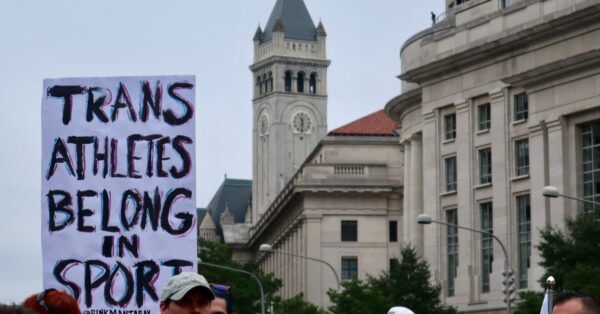
There has recently been much discussion on whether or not transgender athletes should be allowed to compete in top sporting tournaments. Because the transgender community in the United States and throughout the world is growing every year, it’s critical to design sporting regulations that are both inclusive and equitable to avoid future problems.
Many conservatives are wary of this situation and are against letting transgender athletes participate.
The Associated Press reports that in Salt Lake City, Utah, Republican legislators in Utah overrode a veto and passed a law banning transgender athletes from competing on girls’ sports teams, joining 11 other states with similar legislation.
In his veto letter, Gov. Spencer Cox made the compelling case that such laws prey on transgender children at high risk of self-harm or suicide.
Several prominent business people have also expressed concern that the ban could have a severe economic impact on Utah, including the possible cancellation of the NBA All-Star Game for the coming year. As a result of their opposition, the Utah Jazz labeled the bill “discriminatory legislation.”
Before the veto, most Utah legislators supported the ban, but not enough to override it. On Friday, the bill’s proponents won over 10 House Republicans and 5 Senate Republicans who had previously voted against it.
As the second Republican governor this week to overrule lawmakers on a sports participation restriction, Cox was able to win conservative voters in Utah’s state primary season by presenting the plan to the Legislature. Despite the upcoming elections, some Republicans supported Cox’s decision to defy the prohibition.
“I cannot support this bill. I cannot support the veto override and if it costs me my seat so be it. I will do the right thing, as I always do,” stated Republican Sen. Thatcher.
After Cox’s veto was overridden, a dozen states now prohibit transgender students from participating in school sports. The new law in Utah goes into effect on July 1st.
In the past two years, organizations like the American Principles Project began a well-coordinated push to promote legislation regulating the participation of transgender children in sports in every state. As for the National Conference of State Legislatures, at least 25 states have enacted prohibitions since last year. Legislators in Arizona and Oklahoma recently passed bans on the practice.
This fight began with our aid, and we’re trying to keep it going, but a great deal of this is coming from the local level,”
It is said that it is needed to defend women’s sports in Utah, a strongly conservative state. According to MPs, more transgender athletes with possible physical advantages might someday dominate the field and transform women’s sports without legal action.
The prohibition would impact only one transgender student-athlete in Utah’s K-12 system. Four transgender athletes in Utah have not been accused of having an unfair advantage over their peers.
A loss of $50 million in income is estimated by the conference and event organizers Visiting Salt Lake because of the override. Ancestry.com, a genealogy DNA testing company established in Utah, was also opposed to it.
In 2023, the NBA All-Star Game will be held in Salt Lake City. According to league spokesman Mike Bass, the league and the Jazz are “working closely” on this issue. NBA player Dwyane Wade, the father of a transgender child, owns a stake in the team.
Controversial legislation advocates, on the other hand, claim they planned to minimize the impact of boycotts like those that drove North Carolina to rescind a law restricting which public facilities transgender people may use. With this strategy in mind, the American Principles Project targeted populous, economically powerful states that would lose significant investments if they left. Due to relatively mild economic blowback history, the organization anticipates more minor conditions being treated similarly.
According to legislative leaders in Utah, there was no threat of boycotts in Texas or Florida who argued that the NBA’s decision to pull out of Salt Lake City was premature.
To preserve women’s sports and make women’s sports safe and competitive, I hope the NBA and other organizations understand our goal here. That’s fine with us, and if they have any ideas on how to do it, we’d love to hear them,” said Utah Republican House Speaker Brad Wilson.
Utah has always been one of the most conservative states in the country. Newcomers and technological firms and the expanding influence of tourism often lead to heated debates about social concerns in Utah. This state is home to The Church of Jesus Christ of Latter-day Saints.
Pro- and anti-ban demonstrators converged on the state capitol building in Salt Lake City on Thursday and Friday.
After more than a year of wrangling, social conservatives and campaigners for lesbian, gay, bisexual, and transgender equality finally reached an agreement on Friday. An Equality Utah activist helped sponsor Rep. Kera Birkeland’s bill, which would require transgender student-athletes to appear before a government-appointed committee.
Both sides of the argument rejected the suggestion, even though it was presented as a compromise. Republican legislators appointed commission members based on bodily dimensions, including the hip-to-knee ratio, which LGBTQ advocates objected to.
An all-out prohibition substituted the legislation in the closing hours before the Legislature was scheduled to adjourn earlier this month.
Birkeland , a basketball coach, recognized that the suggestion elicited strong feelings in meetings with female student-athletes.
This is not a problem for us in our state. We tell those girls to sit down, be quiet, and be kind,” she continued.
Athletes in Idaho and West Virginia have filed lawsuits claiming that the regulations violate their civil rights, so lawmakers expect similar legal battles. It is claimed that the prohibitions violate their privacy rights because of the testing required if an athlete’s gender is contested.
If the ban is overturned in court, state policy will revert to the commissions.
School districts and the Utah High School Athletic Association were concerned about lawsuits. However, the latter group has stated that it lacked the financial resources to defend the regulation in court. Also, on Friday, lawmakers changed the ban so that taxpayer money may be used to cover the costs of possible litigation and shield districts and the association from culpability.
Like the rest of the world, Americans are continually changing, and top sports must adapt. This is particularly important for transgender athletes, who should be treated equally and fairly in sporting events.
